




Project
FanDuel Hackathon
Role
Lead Product & Motion Designer
Team
Product · Engineering · Creative
Scope
Product Strategy · UX/UI · Interaction · Motion · Prototyping
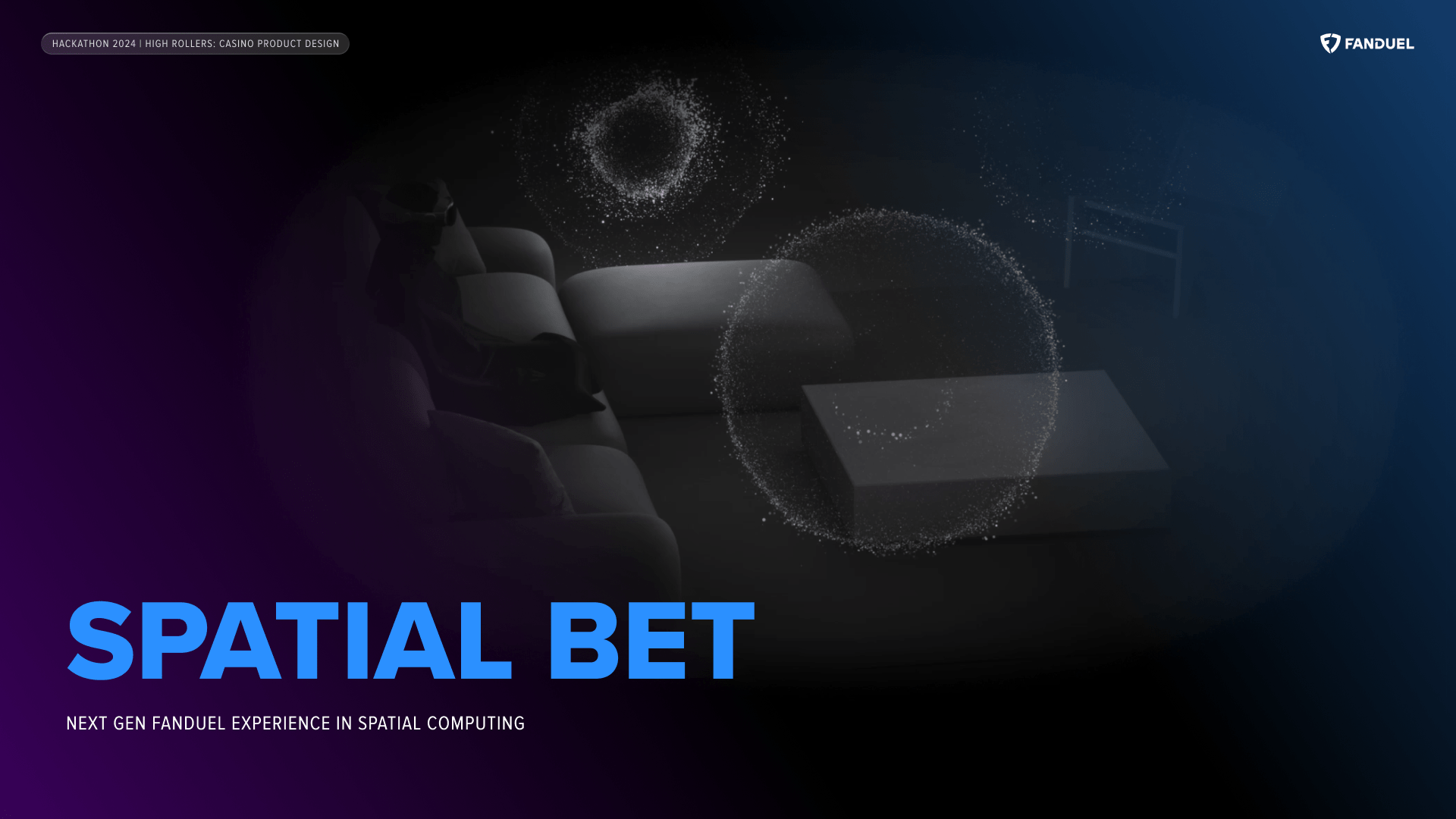
Reimagining FanDuel for spatial computing
Exploring how Sportsbook, Casino, and live games could extend beyond the screen through spatial interaction, AR, and immersive experiences.
My Role
I led the product, motion, and spatial design direction, working across design, product, and engineering to explore how FanDuel's core experiences could translate into spatial computing.
I helped shape the research direction, define the product concepts, and lead interaction, motion, and visual exploration across Sportsbook, Casino, and AR live-game experiences.
Team
Design, Product, Engineering
THE OPPORTUNITY
What happens when FanDuel no longer has to live inside a screen?
FanDuel's Sportsbook and Casino experiences were built around traditional 2D interfaces. With emerging platforms like Apple Vision Pro and AR, we saw an opportunity to rethink how customers could experience betting and gaming in a more immersive environment.
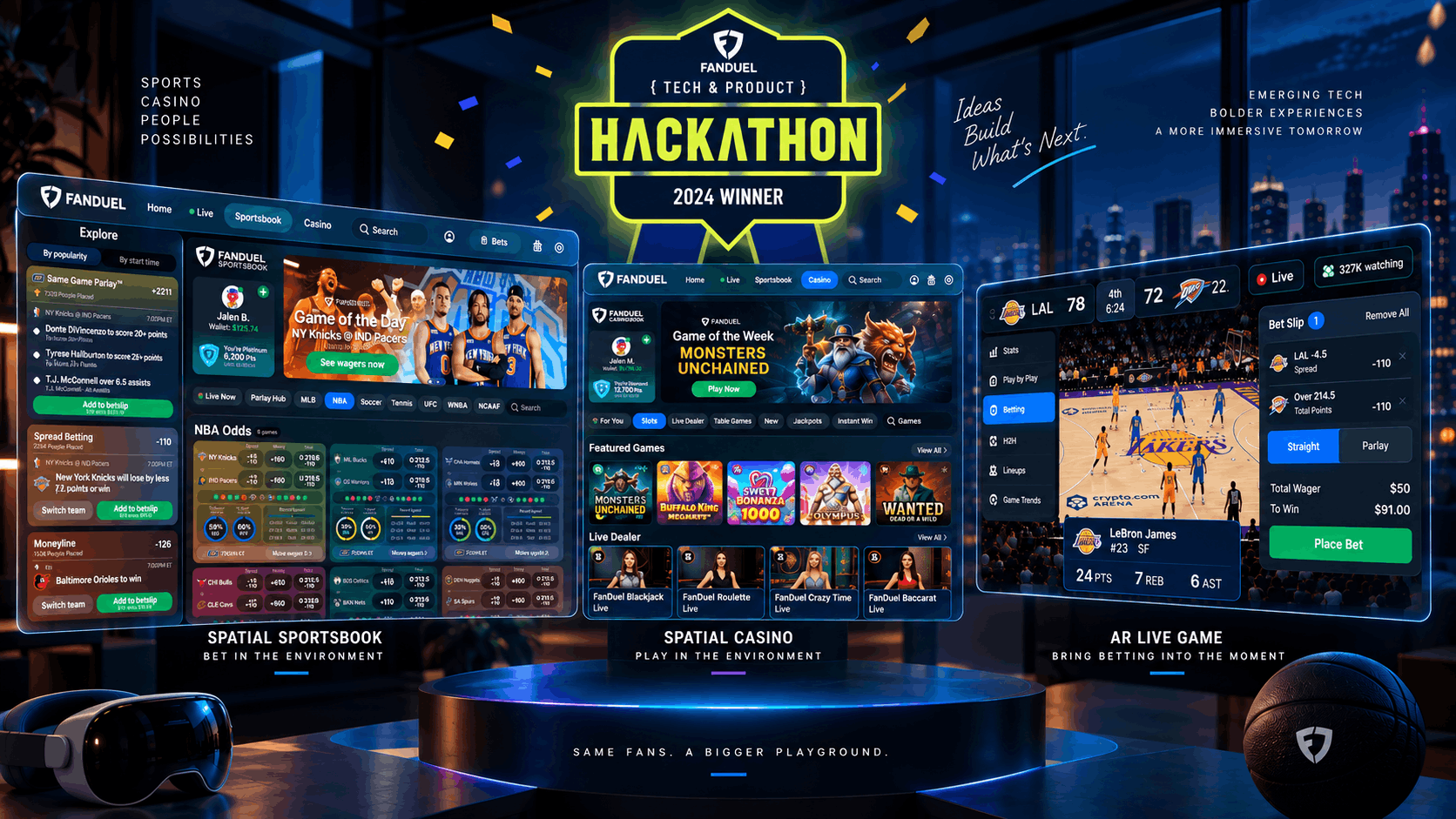
Rather than simply recreating existing experiences in 3D, we explored three directions:
Sportsbook
Making live betting and sportsbook information more contextual.
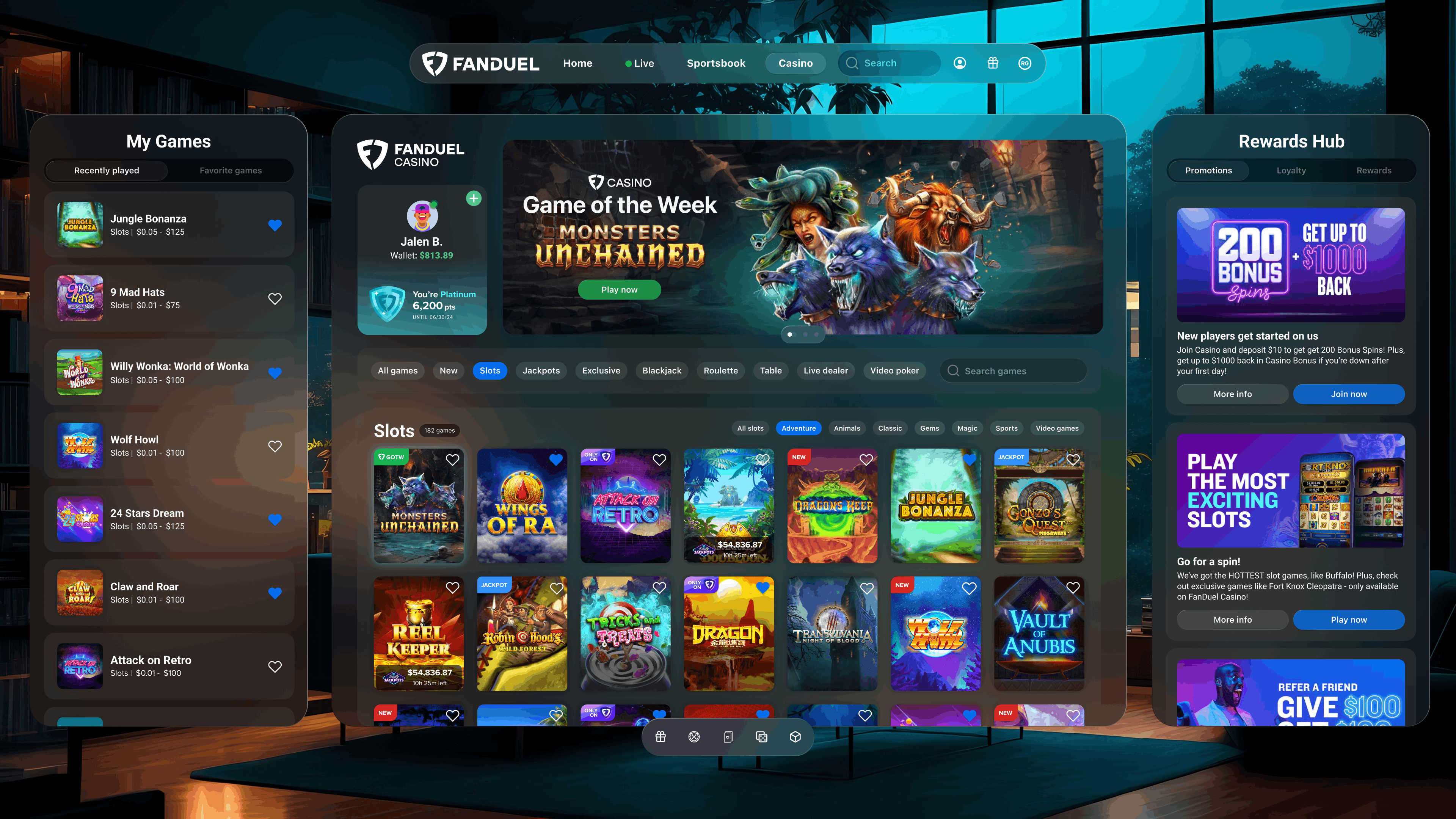
Casino
Exploring how casino gameplay could become more immersive and spatial.
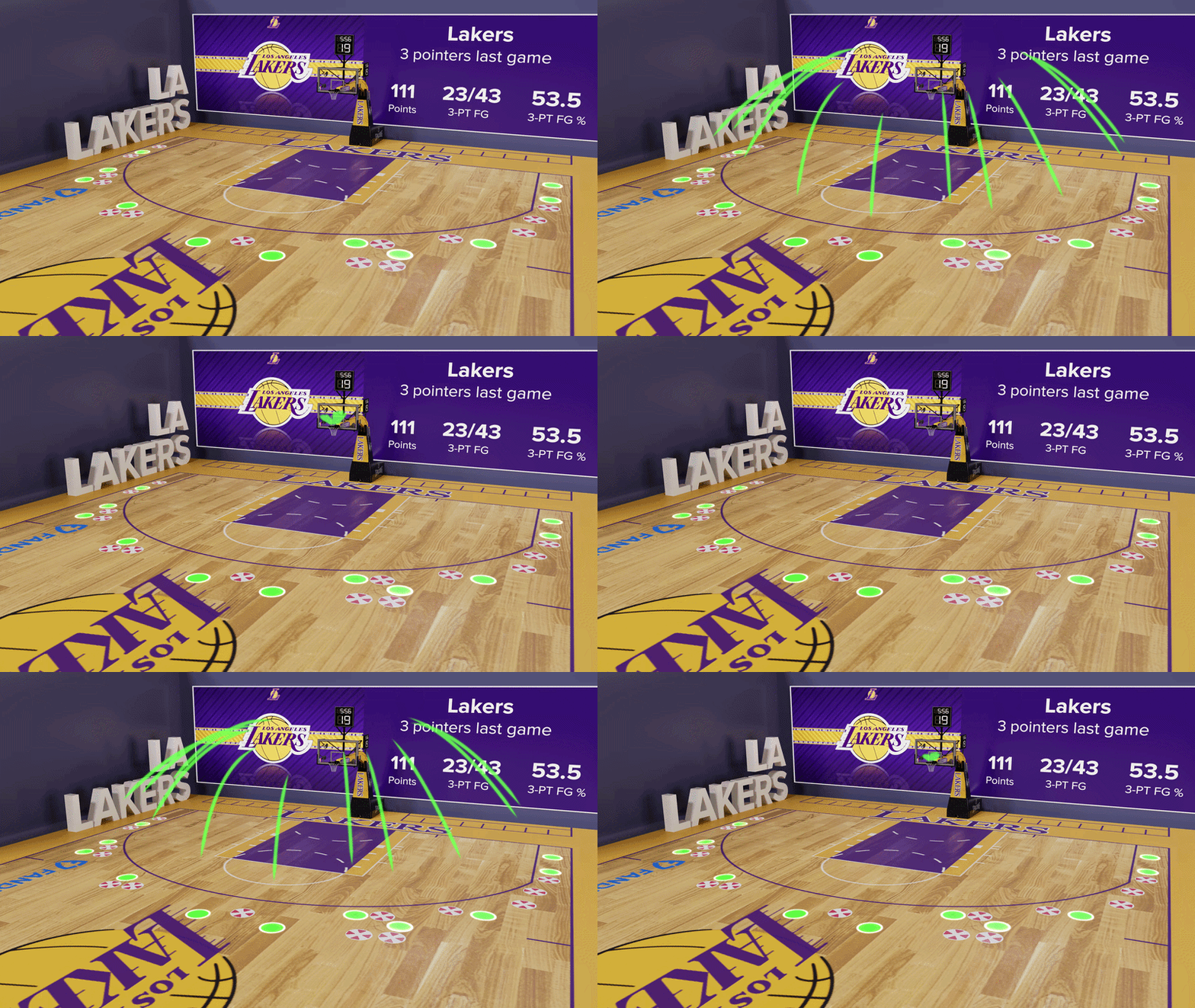
AR Live Game
Connecting the physical experience of watching a game with live odds, stats, and betting.
The goal wasn't to design for a new device.
It was to explore what becomes possible when the screen is no longer the constraint.
THE EXPLORATION

VALIDATING THE CONCEPT
Once we established the direction for Sportsbook and Casino, we wanted to understand how users would respond to the experience and whether the spatial interactions felt compelling.
We conducted unmoderated concept testing with 5 users per product across Sportsbook and Casino, focusing on initial reactions, engagement, desirability, and visualization preferences.
USER INTERVIEWS
"This is awesome, very immersive!."
“I like the way that the data points are displayed"
What we learned
Live betting resonated
Users were particularly interested in placing live bets and parlays while watching a game, reinforcing the potential of spatial betting during live events.
The experience felt immersive
Users described feeling immersed when betting and gaming extended beyond a traditional screen.
The visual direction created excitement
Users described the concepts as vibrant and fun, with some expressing an immediate desire to use FanDuel.
FROM RESEARCH TO REFINEMENT
The research reinforced that immersion and context were valuable, while highlighting the importance of keeping the experience focused and intuitive.
We used those insights to refine the spatial hierarchy, interaction patterns, and visual language across the concepts.
Our design principle became simple: use space to create context, not complexity.
01 — SPATIAL SPORTSBOOK
Bringing live betting into the environment
Traditional sportsbooks rely on dense screens, tabs, and navigation. For spatial computing, I explored how live odds, bets, and supporting statistics could exist as spatial zones around the user.
Primary betting actions stayed within comfortable reach while supporting information occupied surrounding layers.
Depth created hierarchy.
Motion communicated live changes.
Gaze and gesture became part of the interaction model.
The result was a sportsbook designed around the user's environment rather than a fixed screen.
02 — SPATIAL CASINO
Making casino gameplay more immersive
The Casino exploration asked a different question:
What does casino gameplay feel like when the game can exist around you?
Rather than placing traditional casino UI into a 3D environment, we explored how the physicality of casino gameplay could become part of the experience.
Game elements could occupy spatial positions around the player, creating greater depth and presence while keeping the core gameplay recognizable.
The goal was to balance familiar gameplay with the possibilities of a new medium.
03 — AR LIVE GAME
Connecting the game you're watching with the bets you're making
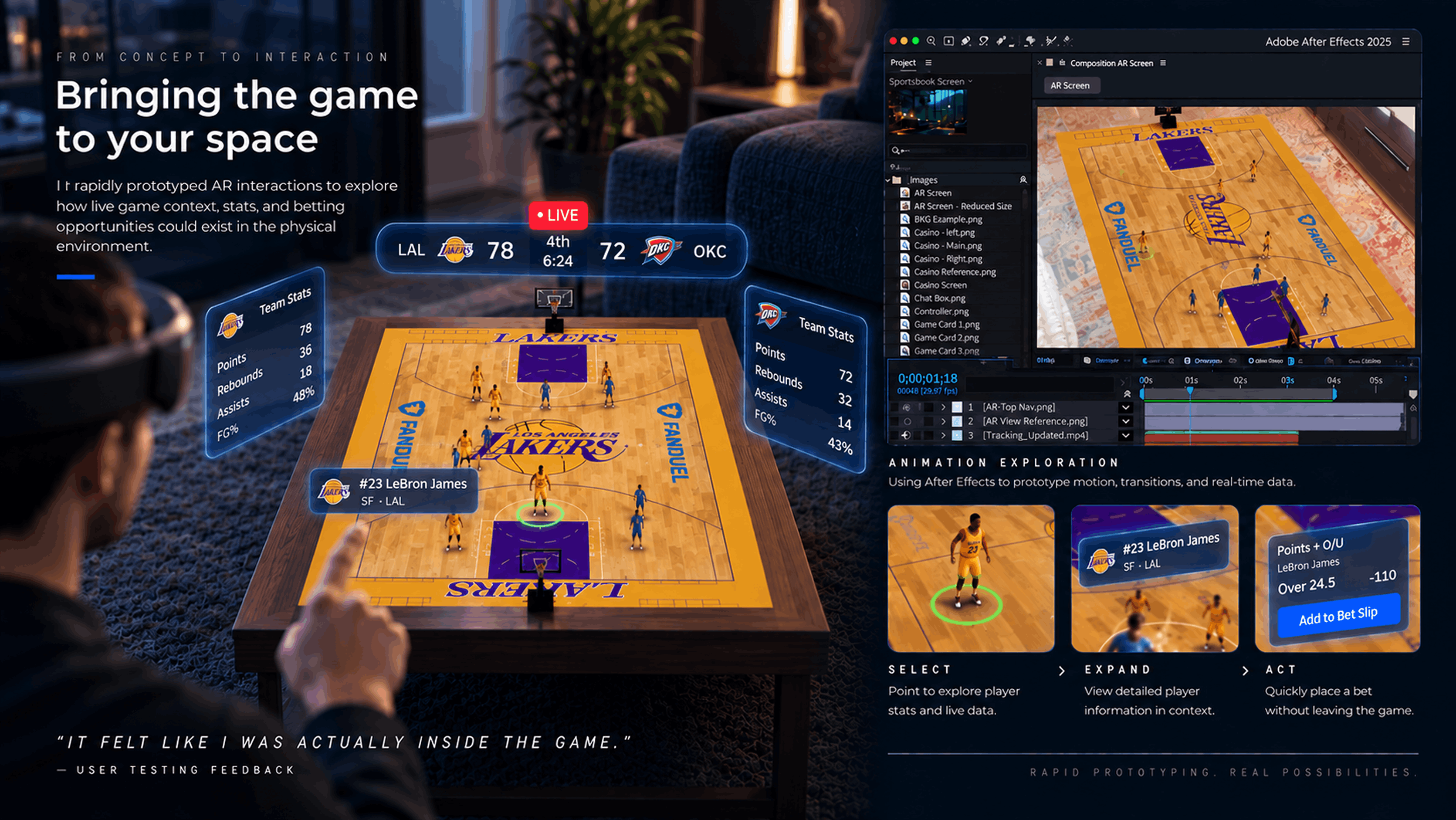
The AR concept explored what happens when FanDuel becomes part of the live sports-viewing experience.
Instead of looking down at a phone while watching a game, relevant information could appear within the physical environment.
Live odds, statistics, and betting opportunities could surface contextually around the game, creating a bridge between the physical experience of watching sports and the digital experience of betting.
Watch the game.
See the context.
Act when it matters.
DESIGNING A SPATIAL SYSTEM
Although each concept served a different purpose, we established a consistent set of principles across the experiences.
Depth creates hierarchy
Information closer to the user represented higher-priority actions, while supporting content could recede into the environment.
Motion creates context
Movement communicated live updates, attention, transitions, and changes in state.
Spatial zones reduce complexity
Instead of stacking information into traditional screens and menus, content could be distributed throughout the environment.
Familiarity anchors exploration
We preserved recognizable FanDuel patterns where they helped users understand the experience, while introducing new interactions where spatial computing created genuine value.
BALANCING IMMERSION WITH CLARITY
One of the biggest challenges was knowing when more immersion actually made the experience worse.
More information and movement could make the experience feel impressive, but they could also compete with the game or increase cognitive load.
We therefore prioritized:
Context over density.
Hierarchy over spectacle.
Interaction over decoration.
This became especially important for the AR live-game experience, where the physical game remained the user's primary focus.
MOTION AS AN INTERACTION MODEL
Motion wasn't added simply to make the concepts feel futuristic.
I used it to communicate:
- Live changes in odds
- Where attention should move
- Spatial hierarchy
- Transitions between states
- Interaction feedback
- Game and betting moments
This made motion part of the product's communication system, rather than a visual layer added afterward.
RAPID PROTOTYPING
Because this was a time-constrained hackathon, we needed to communicate complex spatial interactions quickly.
I led rapid exploration across product, motion, AR, and visual design, moving from concepts into prototypes that demonstrated how the experiences could behave.
The prototypes helped us evaluate not just what the interfaces looked like, but how they felt and behaved in space.
THE FINAL VISION
Together, the three concepts explored a broader vision for FanDuel:
Sportsbook could make betting more contextual.
Casino could make gameplay more immersive.
AR could connect betting to the physical experience of watching a game.
Rather than treating spatial computing as another platform to design for, we explored it as an opportunity to rethink the relationship between people, information, games, and their environment.
THE RESULT
🏆 FAN DUEL HACKATHON 2024 WINNER
The concept gained traction internally and was selected as the 2024 FanDuel Hackathon winner.
More importantly, the project demonstrated how an emerging technology could be explored through user research, product strategy, interaction design, and rapid prototyping rather than simply creating a futuristic visual concept.
WHAT I LEARNED
The biggest takeaway wasn't about designing for Apple Vision Pro or AR.
It was learning how to design when established product patterns don't exist yet.
Start with the user problem, not the technology.
Research helped us understand where spatial computing created genuine value. Exploring Sportsbook, Casino, and AR together allowed us to think beyond a single interface and consider what a broader spatial FanDuel ecosystem could become.
What began as an exploration into spatial betting became a clear vision for the future. By reimagining the experience for devices like Apple Vision Pro, we showed how immersive design can extend the brand beyond the screen and unlock new interaction models. The concept gained immediate traction and won the internal hackathon, positioning our team at the forefront of spatial product thinking.